toolset refinement

I was once amusingly characterized as mistaking the acquisition of learning tools for actual learning.  In fact, it almost seemed like a fair point at the time.  However, I’ve noticed that my toolbox is becoming ever more lightweight as time goes on.

I started with a few textbooks and reference books, most of which I no longer use.  Also, at one point near the beginning, I had sixteen apps on my iPhone relating to Japanese study.  Now I use three.  As for websites, the sites I use have also gotten fewer in number, as have the blogs I read.  It’s like an apprentice woodworker, who might start with a dozen planes in his toolbox but eventually finds he never uses ten of them.

All that notwithstanding, I don’t think there were any mistakes in that approach.  Some of these tools, like the excellent Human Japanese app (an introductory text with quizzes and games), were only useful at certain times.  When they were useful, I got a great deal of use out of them, but they have been outgrown.  Others had duplicate functionality, or near to it – and how would I know which I liked had I not tried both?  I don’t think language learners should ever be concerned about getting too many resources, too many tools.  You don’t know what will click with you until you try it, so if it looks even remotely useful, by all means acquire it and give it a go.  If it wasn’t right for you, there’s an easy way to tell – it’ll collect dust.  And if it was, it just might become indispensable, at least for a while.

I think towards the end of one’s language learning curve all you’d need would be something to read, something to review, and a dictionary.  And once the language is mastered, you’d have your library and nothing else.

haiku friday

瓜貰う・太陽の熱・さめざるを

うりもらう・たいようのねつ・さめざるを

Given a melon with all the heat of the sun still warm within it.

山口誓子, 1950

i won readmod

But, in fairness, so did everybody that participated.  I heard quite a few comments to the effect of “I never imagined I could actually read this much real Japanese, and in only one month” – and I’ll add my signature to that line as well.  At the beginning of the month I looked at my pace and concluded that, perhaps, with a strong effort, 200 pages might be possible; and in fact I did end up with 204 pages, and it wasn’t even that hard.  Also, I must here register my astonishment at the actual winner of the contest, BlackDragonHunt, and the runner-up, Seizar86, who both somehow managed to read over 2000 pages.  I don’t know that I’ve ever read that much in one month in English (not that I kept track), and I considered myself a thoroughbred bookworm.

Now, of course, the question is, was extensive reading more effective than vocabulary study and sentence SRSing?

And the answer is: I still don’t know.  More precisely, I don’t know if it was, at this point in time.   Later on I believe it would be (although I don’t think one would ever want to abandon SRS entirely, because rarer vocabulary and usages wouldn’t be reinforced adequately simply through extensive reading), and that is for one very simple reason (that Kanjiwarrior already brought up in his post about this); namely, that reading is an enjoyable pastime that one can cheerfully do all day long, but SRSing is work, and one can only do so and so much work.  So while, true, SRS is probably more efficient (not that it can be considered fully in isolation, because you have to get sentences from somewhere), several hours of reading is going to beat half an hour of SRS every single time.

That it works, and very effectively, is however not in question at all.  I noted that in the month of reading, while my vocabulary didn’t go up much, my comprehension level certainly did.  Also, my own early experience in English is a good indication.  I was reading Dickens at age 6 or 7.  And no, absolutely I did not fully understand what was going on.  But I understood enough to enjoy it, so I kept reading, and reading, and reading.  I was blessed to grow up with a large library and by the time I was ten or so I’d read nearly everything in it.  Being an only child, and growing up in the country, it was a pretty quiet time; so I think I can be fairly confident in saying that my current English ability (such as it is) is mainly due to this same extensive reading.  Even a fairly brief time can be highly beneficial, as is recorded in two case studies on antimoon; the one student recorded remarkable progress in the span of a single summer, and the other over only two years.

So why do I still have doubts about whether extensive reading is the best way to learn right now, and in Japanese?

Firstly, I found that as long as I stayed within the confines of the lower level graded readers, I could easily understand what was being said; but as soon as the grammar got a little more complex, in the advanced readers and certainly in the various non-didactic Japanese sources I used, I got lost very quickly.  Therefore, I think I would benefit from a little more study of grammar construction before charging forward.  And yes, I know, no one explains grammar to a Japanese baby; but the reason for that is that they don’t know any language at all!  As soon as you have a good grasp of one language, you have both an understanding of how a language works, and a framework to discuss it.  So while a child must learn strictly by example, because no other way is possible, an adult can quickly understand grammar with a simple explanation and a few examples, after which recognizing the constructions in the wild is far easier.  Naturally there is no point overdoing grammar study; this isn’t math or chemistry.

Secondly, I found that I was still far too dependent on furigana.  I want to learn kanji readings as quickly as possible now (which will probably mean RTK2, I think), and that will make a tremendous difference in reading ease.  At the moment, without furigana, sounding out new words is impossible, and looking them up is impractical – it takes too long and interrupts the flow of reading.

Worth mentioning is the importance of rereading.  Those Dickens novels I mentioned before – I don’t know how many times I read Great Expectations over the course of my education, but it was quite a few.  Each time I understood more, and each time I remembered more.  Rereading is what brings the SRS effect into extensive reading, and adds greatly to its effectiveness.  However, for the contest, since I was attempting to maximise my pagecount, I did no rereading at all.  I would suggest that a partial score be implemented for rereading in the next holding of the reading contest; perhaps count 0.5x pages for the first rereading and 0.25x thereafter, or some system like that.

So what now?  Certainly I’ll keep reading, but I think it’ll be a few months still before I can make it my main focus again, this time for good.  For now, I’ll finish core2k, build my sentence deck, and start working through RTK2.

どうもありがとうございました to LordSilent for hosting this contest.  It was a great experience.

core2k kanji stats

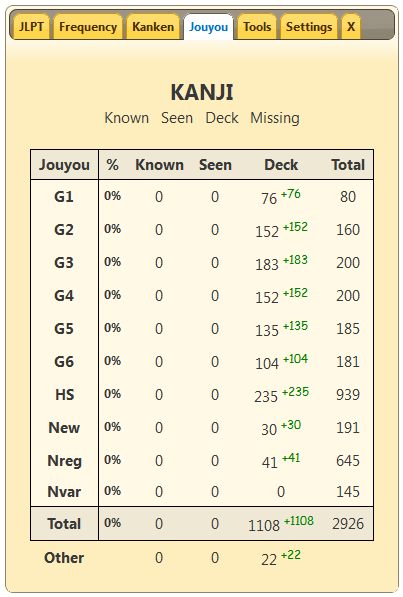
I was curious about kanji stats for the core 2000 anki deck I made, so I fiddled with the tags and model names and so forth until JxPlugin deigned to give me some numbers.  This includes kanji in all sentences, not just vocabulary words, although I think those two figures should be the same.  So a bit over half the jouyou kanji are present in these sentences.

core 2000 kanji stats

Comments Off on core2k kanji stats Posted in kanji, Trivia

smart.fm: taking a new tack

I’ve been using smart.fm for a while now, mostly working my way through the core 2000 series of vocabulary goals.  As good as smart.fm is, it has some failings which have led me to start using it a little differently.

There are two main problems.  The first is that there is no way to undo an answer.  Since you don’t grade yourself, the first answer you give is the only answer you’ll have a chance to give.  Therefore, if you make a typo whilst entering the text for the last phase of questions, smart.fm will assume you actually did not know the word, and set back your progress a week or more from where it should be.  The next problem compounds this, as well as being a serious nuisance on its own.  Normally, to “master” a word, if you get the answers right every time the question will come up four times.  If you have some trouble with the word, of course you’ll need to answer it more often.  The problem is with the timing.  It seems smart.fm’s SRS system does not properly take into account the need for more frequent reviews of problem items.  As the goal progresses toward the end, naturally the reviews come further and further apart; but problem items also come further and further apart.  That is why a goal can sit at “99%” for ages.  There are items you haven’t mastered, but instead of asking you at the appropriate intervals it just lets them sit there at timings commensurate with those for items you already know.

Then, once the goal is at last complete and you’re in the long-term review mode, the frequency the cards come up is set in stone.  A true SRS will give you grading options so that items that are still a little difficult can be marked “hard” or whatever scale the system uses, and easy items can be marked “easy” or “5” or whatever, to optimize the efficiency of reviewing.  But with smart.fm the question is answered either correctly or not, and therefore the spacing cannot accommodate your real requirements.  (In fact, if you do answer a “mastered” item incorrectly, it remains at “mastered” status, so I don’t even know if it takes your answers into account at all once in long-term mode.)

The core 2000 goals have their own unique drawbacks once you want to really master (not “master”) the words; namely, they’re too easy!  With every review, you get the audio and a related image – and sometimes the meaning of the word is actually in the image.  This is brilliant for initial acquisition, but it becomes a limit to the depth of your memory.

Hence my new and slightly different approach to this.  I believe this will take best advantage of the real strong point of smart.fm, namely, initial vocabulary acquisition.  That, it is really brilliant at.  So now, once the goal is at 98% or 99%, instead of waiting for the incomplete words to leisurely make their way to the front, and then continuing with the very inadequate long-term reviewing, I have made a deck in Anki (just modified the shared core 2000 deck, actually), that I will be using for the final phase.  I’ll be reviewing from kana to kanji, in order to best memorize the kanji readings.  This will of course require me to write the sentence for each review.  As I complete each goal on smart.fm, I’ll stop reviewing it there, unsuspend the cards in my Anki deck, and carry on from there.  The one thing I still need to do for this deck is to optimize the initial timing; once I’ve passed a card for the first time, I don’t want to be seeing it again nearly as soon as the default time, because I already mostly know it from my smart.fm reviewing.

edit: a couple points that people reminded me of.  You can actually turn off the audio and images if you want – I’d forgotten that because I’d never actually done it 🙂 Also, I should mention that this is all based on using the iKnow! app; I have done very little with Drill Beta.  However, as far as I know, the background timing control is the same between them.  Please correct me if I’m wrong on that.

haiku friday

From now on (when I remember) on Fridays I’ll be posting a selected haiku of Yamaguchi Seishi (山口誓子).  These are taken from The Essence of Modern Haiku.  楽しみに!

星よりも・明蛍火の・生ける火は

ほしよりも・めいほたるびの・いけるひは

The living fire of a firefly glowing brighter than a star

(1972)