haiku friday

海に出て・木枯かえる・ところなし

うみにでて・こがらしかえる・ところなし

Once over the sea, winter winds can no longer return home again.

Vocabulary of interest: 木枯らし, winter wind, literally means “tree-witherer”.

In addition to the nature image, this poem also contains a very sad secondary meaning.  Can anyone guess what it is?

instinctive srs

The other day it occurred to me that I’ve been using SRS my whole life to learn language.   Chances are, you have too.

Think for a moment about what the average kid newly fascinated by books does, without ever having heard of Anki.   Show her a new book and it is immediately devoured, with frequent questions being asked of the parents.   But it doesn’t end at the one reading; the book is read over and over and over, several times a day perhaps, then less often as other books show up, then whenever she remembers it, until the time comes that she has outgrown it entirely.  This process continues (for the more bookish sort of kid like myself) well into the teen years – I probably read Treasure Island a dozen times, for example.  And the last few times I read it were further and further apart.   I would suggest that this is a typical, normal pattern; and is the mind’s way of instinctively reinforcing what it has learned.   While there might not be a conscious moment of thinking “ah, this memory is getting fuzzy, better reread”, I believe that this is actually what is going on subconsciously; although, if you asked the child in question why she hadn’t read such a book lately, she’d just say she was “tired of it”.   At that point, the reinforcement that comes from randomly seeing the words in the immersive native-language environment is good enough to keep the memory alive.

Using an SRS program can sometimes give the illusion that a memory has a defined point, precisely calculated by the computer, where the fact is deleted from the drive.   Of course, that isn’t actually the case; rather, they get a little fuzzier every day until at last they can’t be recalled at all.  Since the precise date of being reminded isn’t nearly as critical as the program suggests, it might well be that this sort of instinctive SRS is just as efficient as the more regulated and high-tech variety.

Adults, you might think, don’t tend to come back to books or other media again and again, and therefore it might not work too well to depend on this sort of instinct.   That may well be true mostly, but there’s one area where nearly everyone follows this pattern throughout their lives, and that is music.  So here’s your homework (and mine): take the newest Japanese songs that are in heavy rotation on your playlist, get the lyrics (maybe from jpopasia or goo), and make sure you understand them fully.  This isn’t extensive reading where you can skip over things; you’d want to get every word down.  Then, just listen to music as you normally do, no need to enter the whole song into Anki.   I suspect that a few months down the road, when you think of listening to that album again after it’s been collecting dust for a while, you’ll still remember everything you learned.

extensive reading resources

You’ll note a new menu on the sidebar, in which the interesting part is the last page; I’ve put together a bit of a links page specifically to gather resources for extensive reading.  There’s enough text linked there already to keep anyone busy for years, but if you have more of such sites, by all means let me know about them.

Comments Off on extensive reading resources Posted in Administrivia

custom searches in google chrome for sentence mining

So the other day I finally started going through the second volume of Remembering the Kanji – this time it’s all about learning kanji readings.  Heisig groups the kanji as logically as possible, to make it easier to learn groups of characters at once, and provides example words for each reading.  I seem to do well with this sort of systematic approach, so after last month’s tadoku contest reminded me once again with great force how far I have still to go with the kanji readings, I decided it was high time to set this particular machine in motion.

Sentence mining in the usual manner is a bit of a shotgun approach – you never know what vocabulary you’ll get next.  Conversely, what I needed here was a way to quickly find example sentences for a particular word.  To do this most efficiently, I set up some custom search engines in Chrome.

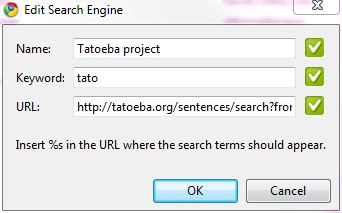
To do this, go to your options, and pick “manage” beside the search dropdown menu in the “basics” tab.  This will bring up a list of search engines.  Click “Add” and you’ll get a little dialogue box that you can fill in like so:

Call it whatever you like.  The second line is the keyword that you’ll use in the omnibar, and the third line is the search URL itself.

I set up four searches, as follows:

Tatoeba, keyword “tato”;

http://tatoeba.org/sentences/search?from=jpn&to=eng&query=%s

Reading Tutor, keyword “rdt”;

http://www.google.com/search?ie=UTF-8&q=site:http://language.tiu.ac.jp/+%s

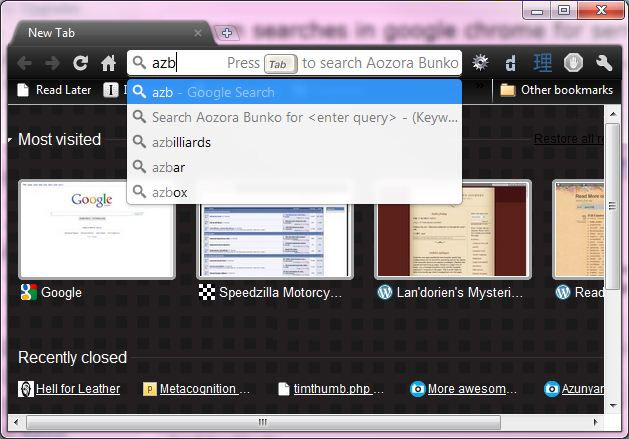
Aozora Bunko, keyword “azb”;

http://www.google.com/search?ie=UTF-8&q=site:aozora.gr.jp+%s

and Twitter, keyword “twt”;

http://twitter.com/#!/search/%s

You want the keywords not to be anything you’d actually search for, otherwise Chrome will autocomplete the search term instead.  To use these, just start typing the keyword into your address bar, hit tab to tell Chrome you want to use that search engine, and type your search term.  Like this:

Using these custom searches will give you a lot more focused results than a general Google search, and save a lot of time over going to each site.

Comments Off on custom searches in google chrome for sentence mining Posted in Learning Tools

haiku friday

舟漕いで・海の寒さの・中を行く

ふねこいで・うみのさむさの・なかをゆく

Pulling at his oars – fisherman making his way through the ocean’s cold.

山口誓子, 1948

tadoku epilogue

Yesterday once again marked the end of another month-long reading contest over at ReadMOD, and having sent my last update to the automatic abacus at six minutes to midnight, I finished with a grand-ish total of 565.45 pages.  Of this 212.7 pages were of books, 1731.4 of manga (counted at 20%), and the remainder sentences (17 sentences to the page).  This is nearly triple my effort of six months ago where I managed just over 200 pages.

I think this time I got considerably closer to the ideal of what extensive reading is meant to be about.  I got that feeling right from the start, when I finished the several level 4 graded readers I hadn’t looked at yet.  At first I was thinking – “this is too easy, I know almost all these words, this grammar is simple” – but, of course, that is exactly the point.  When you are clipping along and the pages flow readily, the occasional word causing you to think a little, or maybe look it up (I know, not supposed to use a dictionary – but I’m curious!) – that is when you are in the best state to get used to reading and get used to the language.  That’s exactly why it’s recommended to read something at 90% or better comprehension level.  Think of the cyclist in training; instead of struggling up the mountain in the highest manageable gear, stopping every ten metres to gasp for air, he keeps a pace that will allow him to ride steadily for an hour or more.  Do that enough, and eventually that mountain becomes no obstacle at all.

That’s when I ran out of graded readers and piled into my manga.  Sketchbook isn’t really difficult, but suddenly I was finding a lot of new words, a lot of katakana (Kuri-chan’s beloved insects all seem to have names made of a dozen katakana), trying to figure out Natsumi’s dialect (Hakata-ben), and fairly frequently coming to the end of a four-panel strip and having to say “I didn’t get a single bit of that!”.  Sometimes I’d go ten pages without needing to look up anything though – overall I’d say comprehension was in the range of 70ish%.  So not bad at all, but not precisely in the spirit of things.  I finished the six volumes in a week or so, and also somehow flailed through a volume of Zetsubou Sensei, which I could understand enough of to realize that I should wait with the rest until I could fully appreciate its genius.

At that point I’d run out of manga with furigana (sadly, still very dependent on that), so I started rereading.  The readers were easier the second time around, no surprise there.  Then it occurred to me that I’d only ever read through my seven volumes of Yotsuba&! once.  Those were the best days of this contest – back to the flow, enjoying the stories and characters and not worrying about the language.  Rereading a couple of Sketchbook rounded out the month, and those were also a lot easier the second time.  I’m even more convinced now that rereading is one of the keys to making extensive reading work the best.

Aside from all its intrinsic benefits, extensive reading throws weak spots into clear relief.  It quickly became clear what I need to work on the most.  After the contest I had had in mind to study through two more grammar books (I know it sounds terminally dull, but I find it interesting enough that it really helps me; also SRSing the example sentences makes sure that the patterns stick); however, I found that there were very few points where odd grammatical structures gave me pause.  Rather, there’s a tremendous quantity of words that I need to learn.  Also, to break out of the furigana trap, learning kanji readings is top priority.  The plan now is immediately to tackle both problems at once by going through the second volume of Remembering the Kanji, using the order given and most of the example words, and making sentence cards exactly like all my other sentence cards for them.  This ought to give me about 2500 kanji readings and as much vocabulary in roughly four months or so, and once I have most of the kanji readings under my hat acquiring new vocabulary will also become far easier.  Reading will of course continue and more books are already in the mail.

Big thanks again to LordSilent for all his hard work getting this to run as smoothly as it did, and well done to all my fellow participants.