don’t fear the void

Having recently plucked up the courage (or more accurately, resolved to put forth whatever effort was required) to read whatever Japanese text I liked whether or not it had furigana, I have found firstly that it isn’t all that hard and secondly that it has some real benefits.  I probably know 300 or 400 kanji readings, at a guess, just for perspective – as often as not incomplete, as well; just kun-reading or maybe just one on-reading.

This started when I began my second reading SRS deck, which is four-panel manga.  Azumanga Daioh was the choice, for a few reasons; I loved the anime, I already had the books, it was by the same author as Yotsuba& which I also enjoyed immensely, and it didn’t seem very difficult.  (It actually has some unexpectedly uncommon kanji, I’ve found, but still it isn’t hard.  Grammar is as simple as you’d expect in a four-panel.)  Azumanga Daioh does not have furigana, and that was another reason I picked it for this deck.  If my intention was to reread the text as often as needed in order to remember all the words whether they have kanji or not, furigana would simply be a distraction, and a possibly deceptive one at that.

Then I also began the second volume, just reading through it, not SRSing it, in a feeble attempt to get my pagecount for this month’s ReadMOD out of the “embarrassing” zone.  (It’s as I expected a little difficult when most of my reading time is spent on the SRS decks, which I’m not counting.)

I found it quite easier than I expected.  I know enough kanji readings to input an unknown word as “this kanji is the first kanji of this word I know, and then the next one is the first of this other word” much of the time.  When that fails, either using the SKIP input in Kotoba! on my iPhone, or the IME pad and Tangorin on the computer, gets the job done infallibly and doesn’t take very long.

The small amount of additional effort, though, seems to trigger something in the brain that aids memory.  If you have furigana, you just glance up and there’s your reading, no extra time or effort involved, and the kanji barely registers.  But if you have to think about the kanji, consider where else it’s used, or count the strokes for a SKIP input, or even draw it on the IME pad, there is a great deal more involvement.  Maybe it could be compared to sketching a landscape as opposed to taking a snapshot of it.  Both will help you remember, but putting in the time and paying attention to every part of the scene will help you remember much longer and in more detail.

incrementally down the rabbit-hole; or, 不思議の国のアリスの読み方

I have long maintained that for proper maintenance of mental health, it is absolutely essential to read Alice in Wonderland once yearly; and now, since the idea is to read whatever I read in Japanese wherever possible, why not Alice in Japanese?

And just then, Kendo mentioned an interesting SRS concept he was working on.  Usually, incremental reading is used simply to learn facts and make connections between them, but in one’s native language.  Instead, he was taking bits of Japanese text, like short news articles or monolingual definitions, and putting them in the SRS as simply reading cards.  So he was getting the benefit of spaced repetition, without any of the stress of recollection; a sort of hybrid of extensive reading and SRS.

Now these were fairly short snippets of text, but I thought, why not attempt a whole book in this manner, with cards that could be read in five or ten or fifteen minutes each – and that was how the Alice deck was born.  It’s a parallel text, taken from Genpaku and Gutenberg.  The question side is the original text without furigana (for the most part – some of the more difficult kanji (it seems this edition was designed for maybe third or fourth-year elementary school students) have the readings following them in parentheses (I might excise these yet if they are bothersome)), and the answer side is the readings and the English text.  Each chapter is divided into three roughly equal-sized sections, for a total of 36 cards.  You can find the deck as an Anki shared deck to download.  The title is “Alice in Wonderland – 不思議の国のアリス”.

I have great hopes for this method, but can’t comment at all on its effectiveness yet since I’m just starting.   I’ll report back in a month or so.  At any rate, if you are overdue to reread Alice, why not try it this way?

instinctive srs

The other day it occurred to me that I’ve been using SRS my whole life to learn language.   Chances are, you have too.

Think for a moment about what the average kid newly fascinated by books does, without ever having heard of Anki.   Show her a new book and it is immediately devoured, with frequent questions being asked of the parents.   But it doesn’t end at the one reading; the book is read over and over and over, several times a day perhaps, then less often as other books show up, then whenever she remembers it, until the time comes that she has outgrown it entirely.  This process continues (for the more bookish sort of kid like myself) well into the teen years – I probably read Treasure Island a dozen times, for example.  And the last few times I read it were further and further apart.   I would suggest that this is a typical, normal pattern; and is the mind’s way of instinctively reinforcing what it has learned.   While there might not be a conscious moment of thinking “ah, this memory is getting fuzzy, better reread”, I believe that this is actually what is going on subconsciously; although, if you asked the child in question why she hadn’t read such a book lately, she’d just say she was “tired of it”.   At that point, the reinforcement that comes from randomly seeing the words in the immersive native-language environment is good enough to keep the memory alive.

Using an SRS program can sometimes give the illusion that a memory has a defined point, precisely calculated by the computer, where the fact is deleted from the drive.   Of course, that isn’t actually the case; rather, they get a little fuzzier every day until at last they can’t be recalled at all.  Since the precise date of being reminded isn’t nearly as critical as the program suggests, it might well be that this sort of instinctive SRS is just as efficient as the more regulated and high-tech variety.

Adults, you might think, don’t tend to come back to books or other media again and again, and therefore it might not work too well to depend on this sort of instinct.   That may well be true mostly, but there’s one area where nearly everyone follows this pattern throughout their lives, and that is music.  So here’s your homework (and mine): take the newest Japanese songs that are in heavy rotation on your playlist, get the lyrics (maybe from jpopasia or goo), and make sure you understand them fully.  This isn’t extensive reading where you can skip over things; you’d want to get every word down.  Then, just listen to music as you normally do, no need to enter the whole song into Anki.   I suspect that a few months down the road, when you think of listening to that album again after it’s been collecting dust for a while, you’ll still remember everything you learned.

it’s simple math time again

The scholar who studies for four hours at 80% efficiency is far ahead of the one who tinkers with his method for three hours and then studies for one hour at 95% efficiency.

Of course this is overstated; but as much as Khatz and many others (rightly) encourage experimentation, there comes a point where your method is Good Enough.  And then it’s time to stop worrying about how you’re studying, and just get on with it.

sentence srs – the middle of the beginning

It seems since the time I posted that I’d come back to the topic of sentence SRS in a week or so, about five weeks have passed.  Things kept changing as I settled in, and found things that worked and things that didn’t work; more of the former.

I have two decks at present.  One is the core2k deck, and the other is my main, long-term deck.  The core2k deck is disposable and I think I will, in fact, dispose of it shortly.  I’m very tired of the sentences.  They are of course not sentences I picked, so they have no intrinsic interest to me as chunks of meaning (as opposed to exam questions); that’s one problem.  Another (that, in fairness, I could solve with a ready finger on the delete key) is that even in this list of 2000 most common words, there are quite a few that will be mainly found in material that I have no interest in.  The political terms take me a long time to remember and a short time to forget.  Then, there’s also the extremely elementary grammar used.  I can’t learn anything but vocabulary from these sentences, yet they take just as long to review as any other.  Lastly, there’s the matter of the card format.  I started by reading the kana sentence for each card, and writing the entire sentence with the kanji.  Now, while this was effective in that I was learning kanji readings quickly, and my kana writing also benefited greatly (it needed it), it was pretty frustrating because it took a very long time.  There’s something about that number of cards per unit time that makes a significant difference to one’s state of mind about SRS reviewing.  Faster (within reason) is decidedly better.  So then I switched to this:
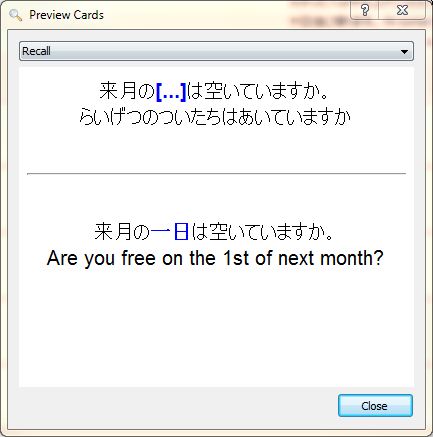
The cloze deletion was the easiest way I could get close to what I wanted; namely, the vocabulary word in question in highlighted kana, with the kanji in the answer; my task being to know the word and write the kanji.  The problem with this is as follows, where the orange line is approximately the path of my eye as I attempt to read the sentence:
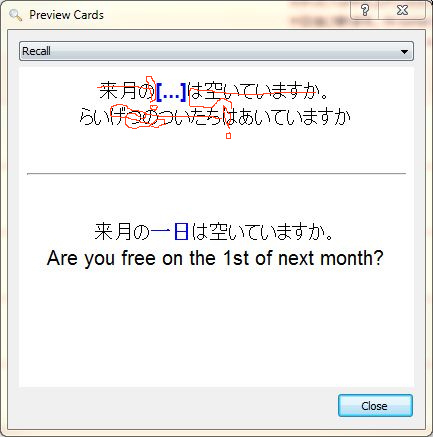
It might not seem like a big deal but after a couple thousand reps it’s starting to make me severely annoyed with the deck.  Enough to make me not want to start reviewing it.  That isn’t right.  I should be looking forward to it.  For the time being I stopped adding new cards (I’m a bit over 600 cards in at the moment) to make the number of reviews per day a little more manageable, and those are down to around 40 now.  This has enabled me to make better progress on my main deck and restart mining.

I don’t think deleting the deck is anything to worry about.  Any words I need will come back to me in the course of normal sentence mining, and since I’ve studied them on smart.fm if I do happen not to have remembered them they’ll be relearned in a snap.

So my main deck is up to just under 500 sentences.  Most of these are from the sentence patterns book I’ve linked to before; the rest are from Naoko Chino’s All About Particles, which is equally good.  I also want to thoroughly go through Shoji’s Basic Connections and Chino’s Japanese Verbs At A Glance, as well as take quite a few from the japanesepod101 upper intermediate lessons that I’m listening to and enjoying all day at work now.  The rest of the 10000 sentences will be taken from the wild.

Also, some of my later cards are monolingual.  Getting to monolingual cards in less than 500 sentences caused me to be inordinately pleased with myself (feel free to mock me in the comments for this!).  I have very few of these so far, but it’s quite clear that they cause you to think in Japanese far more than those with a translation at hand.  Grammar point explanations, though, I have no hesitation in putting in English.  It isn’t like I’ll be thinking of them whilst speaking anyway; they’re just for initial understanding.

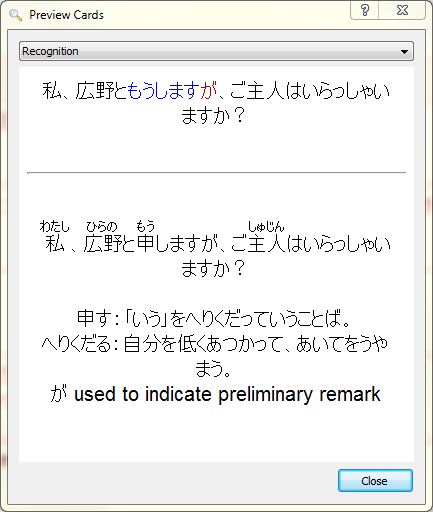
Here’s one of the better samples from this deck:

While the ideal is to have only one knowledge item per card, I don’t see anything wrong with having a grammar point and a vocabulary word sharing a card.  After all, every sentence has grammar.  Here, the vocabulary word is highlighted in blue in the question, and the task is to write the kanji (as well as understand the whole sentence, naturally).  As well, since this sentence has a specific grammar point that it’s meant to illustrate – it’s taken from the epic 13 pages of various uses of が – that part of the sentence is highlighted in red.  The answer contains the sentence with the readings, and a Japanese definition of the vocabulary word.  Incidentally, if I don’t remember the reading of a name, I don’t fail the card.  I’ll worry about name readings later.

Briefly now, a couple of ideas for further sentence mining: firstly, I’d like to stop reviewing my RTK decks eventually, so in order to do this I’d like to go through the kanji in RTK order and find a couple of sentences for each one.  Secondly, I would like to try getting an anime with transcripts, SRSing every part of the transcripts that gives me any trouble (or you could say, that I can learn from), and then watching the show.  Also, of course, anything random that I happen to like from Twitter, blogs, and January’s tadoku.

So, it took a little while, but by now it feels as though I’m finding my groove with this game, and I look forward to much more.

sentence reviewing – yes, just started

It’s a bit embarrassing to admit, but I’ve just very recently started actually reviewing sentences, despite that supposedly being the cornerstone of my entire method.  First there was the kanji to learn, then core2k on smart.fm to go through, and the tadoku month in the meantime, and once I finished core2k I wanted to finish sentence mining Chino’s Sentence Patterns book before actually starting to review.  Well, that’s done now.

So initial impressions then.  Highly effective, yes, and especially (at this point) for learning kanji readings.  I still want to go through RTK2, but I need to figure out how my daily routine will play out with the new things I’m doing.  (It was easy before. smart.fm till done, kanji reviews, kick back with an anime.)  My card shows me the sentence in kana, and my task is to write it with kanji and, of course, understand it.  This is according to Khatz-dono’s thinking in this post.  It might get a bit old after a while, but so far it is no problem to do them all like that.  I think though, once my kanji knowledge has solidified, I’ll review more reading cards, and do less writing, simply because of the time requirement.  If you’re not familiarizing yourself with any new vocabulary or kanji there isn’t much point in writing the sentence, I’d guess.  So far it seems that about a minute and a half is required per sentence, so I can comfortably add about 20 cards from the core2k deck (sigh) and 10 from my main sentence deck, which is about 400 strong, all from that one book so far.

I think I’ll carry on exactly like this for about another week and then post a set of not-quite-so-initial impressions.