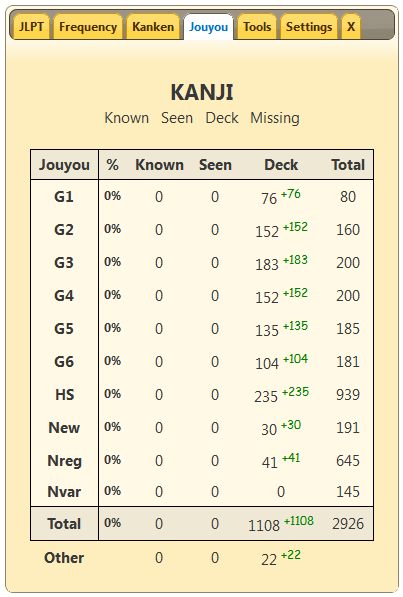
core2k kanji stats

I was curious about kanji stats for the core 2000 anki deck I made, so I fiddled with the tags and model names and so forth until JxPlugin deigned to give me some numbers.  This includes kanji in all sentences, not just vocabulary words, although I think those two figures should be the same.  So a bit over half the jouyou kanji are present in these sentences.

core 2000 kanji stats

Comments Off on core2k kanji stats Posted in kanji, Trivia

smart.fm: taking a new tack

I’ve been using smart.fm for a while now, mostly working my way through the core 2000 series of vocabulary goals.  As good as smart.fm is, it has some failings which have led me to start using it a little differently.

There are two main problems.  The first is that there is no way to undo an answer.  Since you don’t grade yourself, the first answer you give is the only answer you’ll have a chance to give.  Therefore, if you make a typo whilst entering the text for the last phase of questions, smart.fm will assume you actually did not know the word, and set back your progress a week or more from where it should be.  The next problem compounds this, as well as being a serious nuisance on its own.  Normally, to “master” a word, if you get the answers right every time the question will come up four times.  If you have some trouble with the word, of course you’ll need to answer it more often.  The problem is with the timing.  It seems smart.fm’s SRS system does not properly take into account the need for more frequent reviews of problem items.  As the goal progresses toward the end, naturally the reviews come further and further apart; but problem items also come further and further apart.  That is why a goal can sit at “99%” for ages.  There are items you haven’t mastered, but instead of asking you at the appropriate intervals it just lets them sit there at timings commensurate with those for items you already know.

Then, once the goal is at last complete and you’re in the long-term review mode, the frequency the cards come up is set in stone.  A true SRS will give you grading options so that items that are still a little difficult can be marked “hard” or whatever scale the system uses, and easy items can be marked “easy” or “5” or whatever, to optimize the efficiency of reviewing.  But with smart.fm the question is answered either correctly or not, and therefore the spacing cannot accommodate your real requirements.  (In fact, if you do answer a “mastered” item incorrectly, it remains at “mastered” status, so I don’t even know if it takes your answers into account at all once in long-term mode.)

The core 2000 goals have their own unique drawbacks once you want to really master (not “master”) the words; namely, they’re too easy!  With every review, you get the audio and a related image – and sometimes the meaning of the word is actually in the image.  This is brilliant for initial acquisition, but it becomes a limit to the depth of your memory.

Hence my new and slightly different approach to this.  I believe this will take best advantage of the real strong point of smart.fm, namely, initial vocabulary acquisition.  That, it is really brilliant at.  So now, once the goal is at 98% or 99%, instead of waiting for the incomplete words to leisurely make their way to the front, and then continuing with the very inadequate long-term reviewing, I have made a deck in Anki (just modified the shared core 2000 deck, actually), that I will be using for the final phase.  I’ll be reviewing from kana to kanji, in order to best memorize the kanji readings.  This will of course require me to write the sentence for each review.  As I complete each goal on smart.fm, I’ll stop reviewing it there, unsuspend the cards in my Anki deck, and carry on from there.  The one thing I still need to do for this deck is to optimize the initial timing; once I’ve passed a card for the first time, I don’t want to be seeing it again nearly as soon as the default time, because I already mostly know it from my smart.fm reviewing.

edit: a couple points that people reminded me of.  You can actually turn off the audio and images if you want – I’d forgotten that because I’d never actually done it 🙂 Also, I should mention that this is all based on using the iKnow! app; I have done very little with Drill Beta.  However, as far as I know, the background timing control is the same between them.  Please correct me if I’m wrong on that.

haiku friday

From now on (when I remember) on Fridays I’ll be posting a selected haiku of Yamaguchi Seishi (山口誓子).  These are taken from The Essence of Modern Haiku.  楽しみに!

星よりも・明蛍火の・生ける火は

ほしよりも・めいほたるびの・いけるひは

The living fire of a firefly glowing brighter than a star

(1972)

readmod mid-way update

August is half over and therefore so is the ReadMOD.  Herewith a brief report:

In short, I’m at 92 pages, almost all of which have come from my graded readers.  I’ve nearly finished the level 3 set, with one book remaining.  That will provide another 10 or 12 pages.  However, I don’t think I’ll continue to the level 4 set just yet, since the later books of level 3 are really, really stretching my grammar comprehension – in several cases stretching it right past the breaking point.  And I really don’t like not understanding more than 10% at the very most.

So in that case I will have to broaden my sources.  I do have a big stack of manga, so that will get considerable attention.  Unfortunately only two series have furigana though and my kanji reading is still very weak.  よつばと is currently meandering through the postal service towards me – 急げ!  Also, I’m planning to spend a good amount of time on jpopasia reading lyrics.  I like this idea a lot because songs are repetitive, and you’re hearing the text sung as you go along, so it should be pretty effective for learning kanji readings.  Also, lyrics are usually grammatically pretty simple.

The question then is – is this more effective than ordered study?  And the answer is – 1. I don’t really know 2. it depends 3. probably 4. let’s continue another two weeks and answer it then 😉

四字熟語 – four-character compounds

Japanese has a great many expressions made up of four kanji.  These are called 四字熟語 (よじじゅくご – yojijukugo).  That neatly self-referential term can be defined roughly as “four-character mature expression”.  Usually their meanings can be deduced from the kanji, but they are better considered idioms than words.  Many are sourced from Chinese and keep their original meaning, while others are native in origin.

Idioms add spice and colour to any language, and I think the addition of the kanji’s layers of meaning make this especially true of the 四字熟語.

Moreover, I believe that learning these can have the double purpose of learning kanji readings easily.  With every expression you get four readings, and they have a sort of built-in context, which makes learning them easy in the same way that learning phrases can be easier than learning individual words.

I have now taken the 401 most common 四字熟語 and made a shared deck for you anki users.  Search for “yojijukugo – 401 most common”.  There are three other 四字熟語 decks as well, but obviously mine is the best 😉  Big thanks to Kanji Haitani for providing the source material, and to BlackDragonHunt for parsing it into a tab-delimited file and saving me hours of work.

Eventually I want to upgrade this deck with example sentences, but this will do for now.

Edit: here are the kanji statistics for this deck.

The 401 cards in this deck contain:

  • 718 total unique kanji.
  • Old Jouyou: 643 of 1945 (33.1%).
  • New Jouyou: 15 of 191 (7.9%).
  • Jinmeiyou (reg): 21 of 645 (3.3%).
  • Jinmeiyou (var): 0 of 145 (0.0%).
  • 39 non-jouyou kanji.

Jouyou levels:

  • Grade 1: 66  of 80  (82.5%).
  • Grade 2: 100 of 160 (62.5%).
  • Grade 3: 92  of 200 (46.0%).
  • Grade 4: 90  of 200 (45.0%).
  • Grade 5: 68  of 185 (36.8%).
  • Grade 6: 57  of 181 (31.5%).
  • JuniorHS: 170 of 939 (18.1%).

JLPT Levels:

  • JLPT 4: 82 of 103 (79.6%).
  • JLPT 3: 107 of 181 (59.1%).
  • JLPT 2: 276 of 739 (37.3%).
  • JLPT 1: 178 of 922 (19.3%).
  • 75 non-JLPT kanji.

==================

Update 2011-12-10:

A quick follow up on this is probably in order, since people still view this post from time to time it seems. It must be said that the original deck was, for me, an abject failure. Learning more than one reading in a card is a very very bad idea. However; now, much later, when I’ve gotten a great many readings under my belt already, I’ve come back to the 四字熟語 – not this deck, but the deck at readthekanji.com – and now, it’s really coming together. Usually when a new card comes up, I’ll know all the readings maybe a third of the time, three of them another third or so, occasionally two, and almost never one or none. So now my brain can find a home for that new reading, the 四字熟語 with its full reading and meaning, and usually only one reading is unknown or weak. Now that built-in context can really set to work.

So if you’ve come to this page looking for a shortcut for kanji readings, apologies but this isn’t it. There really isn’t one; but, once you’re at more of an intermediate level, with perhaps a solid knowledge of readings for a thousand characters, not all of them per character but the common ones, and some exposure with a bit of recollection for a few hundred more perhaps, at that point studying these 四字熟語 for both their own value as idiomatic expressions and for kanji readings will prove to be of great benefit.