凍る河・見ればいよいよ・しずかなり
こおるかわ・みればいよいよ・しずかなり
The more I look at the river under ice pack, the calmer it grows.
山口誓子、1934

凍る河・見ればいよいよ・しずかなり
こおるかわ・みればいよいよ・しずかなり
The more I look at the river under ice pack, the calmer it grows.
山口誓子、1934
In the society at large (which, be it said, I am not usually a part of), when it becomes known that one is learning a foreign language, generally the first question one receives is “so are you fluent yet?”
And, unfortunately, this question is usually taken seriously and answered in all earnestness, whether “yes” or “not yet”.
I say unfortunately, because this matter of fluency is both something of a myth, and – I was about to say, seldom anyone’s actual goal, but the definitions of “fluency” vary so drastically that it can’t even be determined honestly whether it is anyone’s goal or not. You might think it’s your goal, and then you might think you’ve reached it, and then the next person might come along and think you have very far still to go. Or perhaps that you are far beyond what they would consider fluent.
Some would say that fluency means that you are, linguistically, in every way indistinguishable from a native. If your accent is notably unusual*, or if you commit the occasional amusing error**, you are not fluent, they say. On the other end of the spectrum some say that if you can comfortably get by in ordinary daily life without getting too lost or putting too much additional wear on the pages of your dictionary***, there you go, fluent.
And then let’s say some day you arrive at the point of fluency that you set out towards – will there still be more to learn? Certainly yes, so how will you know when you have “arrived”?
I will have to disappoint anyone hoping that I will propose my own definition. I just don’t think it matters, at all. I would suggest that learners rather focus on what they would like to do in the language; not some arbitrary definition that no two people have ever agreed on.
For my part, I would like to be able to read Japanese as easily as I read English. That’s pretty much it. Will I be fluent? I’m not even going to answer that.
*natives have accents too
**natives do this all the time
***natives look up words too
Tried to come up with a catchy title for this, but, やっぱり無理だ。 Anyway, since last post, I did end up deleting my core2k deck about a week ago, and don’t miss it at all. This has given me quite a bit more time to continue sentence mining, which is mainly still from the particles book, with a smattering of the charming little Cats Blog whenever it has words I don’t know. I guess I like thoroughly working through a single source. About 75% of cards lately have been monolingual (not counting grammar explanations if present).
Here, I’ll let the numbers tell the story.
Deck StatisticsDeck created: 4.5 months ago Total number of cards: 636 Total number of facts: 636 Card Maturity Mature cards: 228 (35.8%) Young cards: 383 (60.2%) Unseen cards: 25 (3.9%) Average interval: 20.0 days Card State Active cards: 636 (100.0%) Inactive cards: 0 (0.0%) Suspended cards: 0 (0.0%) Correct Answers Mature cards: 100.0% (18 of 18) Young cards: 95.5% (1237 of 1295) First-seen cards: 78.1% (542 of 694) Recent Work
It seems since the time I posted that I’d come back to the topic of sentence SRS in a week or so, about five weeks have passed. Things kept changing as I settled in, and found things that worked and things that didn’t work; more of the former.
I have two decks at present. One is the core2k deck, and the other is my main, long-term deck. The core2k deck is disposable and I think I will, in fact, dispose of it shortly. I’m very tired of the sentences. They are of course not sentences I picked, so they have no intrinsic interest to me as chunks of meaning (as opposed to exam questions); that’s one problem. Another (that, in fairness, I could solve with a ready finger on the delete key) is that even in this list of 2000 most common words, there are quite a few that will be mainly found in material that I have no interest in. The political terms take me a long time to remember and a short time to forget. Then, there’s also the extremely elementary grammar used. I can’t learn anything but vocabulary from these sentences, yet they take just as long to review as any other. Lastly, there’s the matter of the card format. I started by reading the kana sentence for each card, and writing the entire sentence with the kanji. Now, while this was effective in that I was learning kanji readings quickly, and my kana writing also benefited greatly (it needed it), it was pretty frustrating because it took a very long time. There’s something about that number of cards per unit time that makes a significant difference to one’s state of mind about SRS reviewing. Faster (within reason) is decidedly better. So then I switched to this:
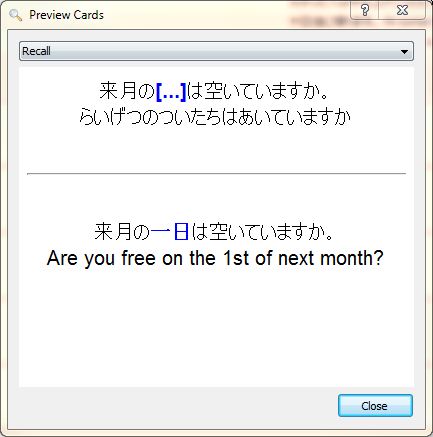
The cloze deletion was the easiest way I could get close to what I wanted; namely, the vocabulary word in question in highlighted kana, with the kanji in the answer; my task being to know the word and write the kanji. The problem with this is as follows, where the orange line is approximately the path of my eye as I attempt to read the sentence:
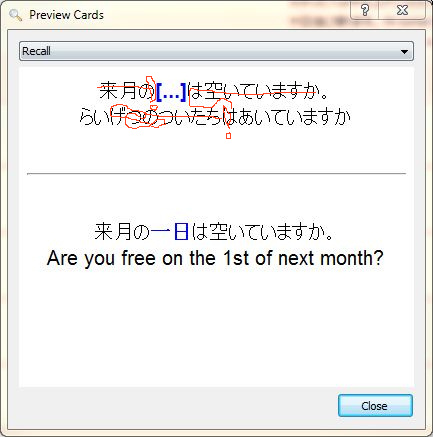
It might not seem like a big deal but after a couple thousand reps it’s starting to make me severely annoyed with the deck. Enough to make me not want to start reviewing it. That isn’t right. I should be looking forward to it. For the time being I stopped adding new cards (I’m a bit over 600 cards in at the moment) to make the number of reviews per day a little more manageable, and those are down to around 40 now. This has enabled me to make better progress on my main deck and restart mining.
I don’t think deleting the deck is anything to worry about. Any words I need will come back to me in the course of normal sentence mining, and since I’ve studied them on smart.fm if I do happen not to have remembered them they’ll be relearned in a snap.
So my main deck is up to just under 500 sentences. Most of these are from the sentence patterns book I’ve linked to before; the rest are from Naoko Chino’s All About Particles, which is equally good. I also want to thoroughly go through Shoji’s Basic Connections and Chino’s Japanese Verbs At A Glance, as well as take quite a few from the japanesepod101 upper intermediate lessons that I’m listening to and enjoying all day at work now. The rest of the 10000 sentences will be taken from the wild.
Also, some of my later cards are monolingual. Getting to monolingual cards in less than 500 sentences caused me to be inordinately pleased with myself (feel free to mock me in the comments for this!). I have very few of these so far, but it’s quite clear that they cause you to think in Japanese far more than those with a translation at hand. Grammar point explanations, though, I have no hesitation in putting in English. It isn’t like I’ll be thinking of them whilst speaking anyway; they’re just for initial understanding.
Here’s one of the better samples from this deck:
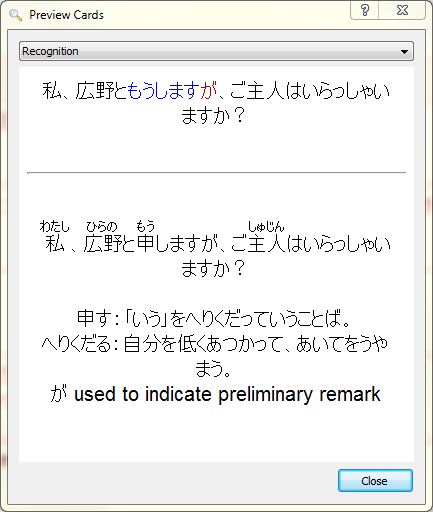
While the ideal is to have only one knowledge item per card, I don’t see anything wrong with having a grammar point and a vocabulary word sharing a card. After all, every sentence has grammar. Here, the vocabulary word is highlighted in blue in the question, and the task is to write the kanji (as well as understand the whole sentence, naturally). As well, since this sentence has a specific grammar point that it’s meant to illustrate – it’s taken from the epic 13 pages of various uses of が – that part of the sentence is highlighted in red. The answer contains the sentence with the readings, and a Japanese definition of the vocabulary word. Incidentally, if I don’t remember the reading of a name, I don’t fail the card. I’ll worry about name readings later.
Briefly now, a couple of ideas for further sentence mining: firstly, I’d like to stop reviewing my RTK decks eventually, so in order to do this I’d like to go through the kanji in RTK order and find a couple of sentences for each one. Secondly, I would like to try getting an anime with transcripts, SRSing every part of the transcripts that gives me any trouble (or you could say, that I can learn from), and then watching the show. Also, of course, anything random that I happen to like from Twitter, blogs, and January’s tadoku.
So, it took a little while, but by now it feels as though I’m finding my groove with this game, and I look forward to much more.
寒庭に・在る石更に・省くべし
かんていに・あるいしさらに・はぶくべし
In the cold garden, they really should have left out more of the stones!
山口誓子, 1962
Incidentally, each of these haiku in The Essence of Modern Haiku includes some comments from the poet and some vocabulary explanations. I thought those pertaining to this poem were particularly interesting.
The stone garden of the Ryoan-ji, in Kyoto. In the cold garden, 15 stones are arranged in groups of 7, 5, and 3. Fifteen is the smallest number possible, but it seems to me, accustomed to working in the short poetic form of the haiku, that more stones should have been left out.
Vocabulary:
更に: “more, again.”
省く = “exclude, omit, eliminate”, and べし is a classical form implying “ought to, should”, so 省くべし literally means “ought to eliminate”. The intended meaning, though, is that more stones “could have been left out”, rather than that they should now be eliminated.
Inspired largely by JapanNewbie’s post on the Kindle 3, I decided to get one for myself. The 3G isn’t very useful where I live, since the web browser is limited to Wikipedia whilst on 3G when not in the US, so I got the basic wifi model.
UPDATE: it seems that this limitation is not correct, and the 3G does work for any site. See Benny’s review on YouTube.
Amazon’s goal with the Kindle has been to make a device that doesn’t feel like a device; that is to say, a device for reading that, when you start reading, just disappears. In this they have been very successful, at least as far as this customer is concerned. Even though reading on an e-reader is still a novelty, once I’ve been reading for a very short while I stop thinking about “wow nifty gizmo” and get drawn into whatever I’m reading, just as with a paper book. The device is extremely thin and light, and takes up about the same space in your hands as a normal smallish novel would, except for being a lot thinner. The display is excellent. Fonts are very crisp and clear – it surprised me to learn that the resolution was only 800×600. Sometimes there is a little bit of glare if you’re working with a single light source at exactly the wrong angle, but this is seldom an issue.
Navigating through menus and within books with the five-way controller is fairly awkward, but that takes up only a small part of your time with the device so isn’t anything to worry about. Likewise, highlighting passages and writing notes is somewhat a pain. The web browser also suffers from having to use the five-way controller to maneuver around, but, again, the web browser is quite incidental. The operating system is simple and intuitive; the problem is that controller. However, without going to a touchscreen and adding dramatically to the cost, I’m not sure how they could have done much better. It works; it’s fine.
Amazon doesn’t sell Japanese books for the Kindle, so you have to find your own. Luckily, this is pretty simple (usually). Various places around the web have free Japanese texts available for download, you can use Instapaper on Japanese websites, and of course there is the treasure trove that is Aozora Bunko.
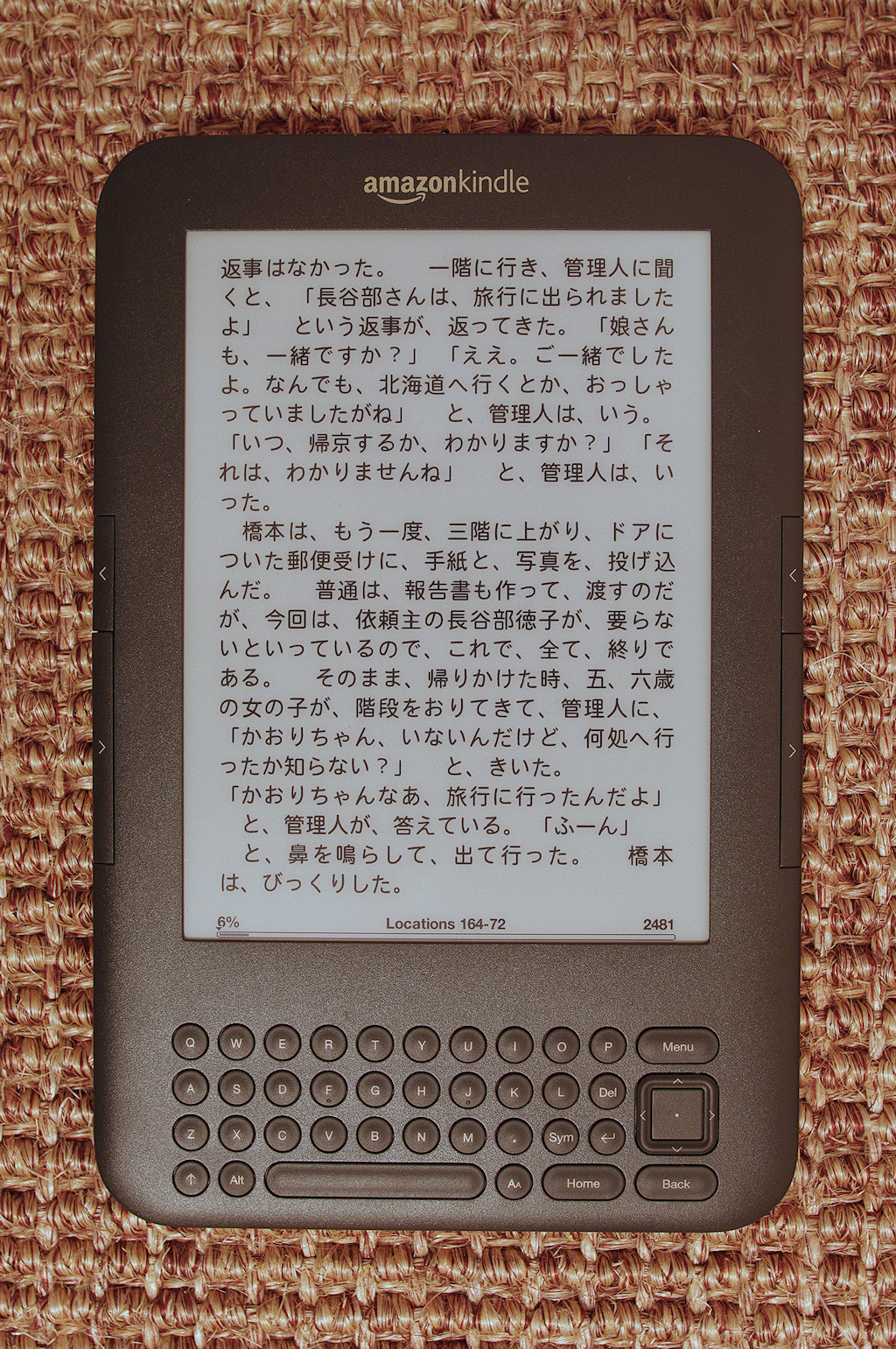
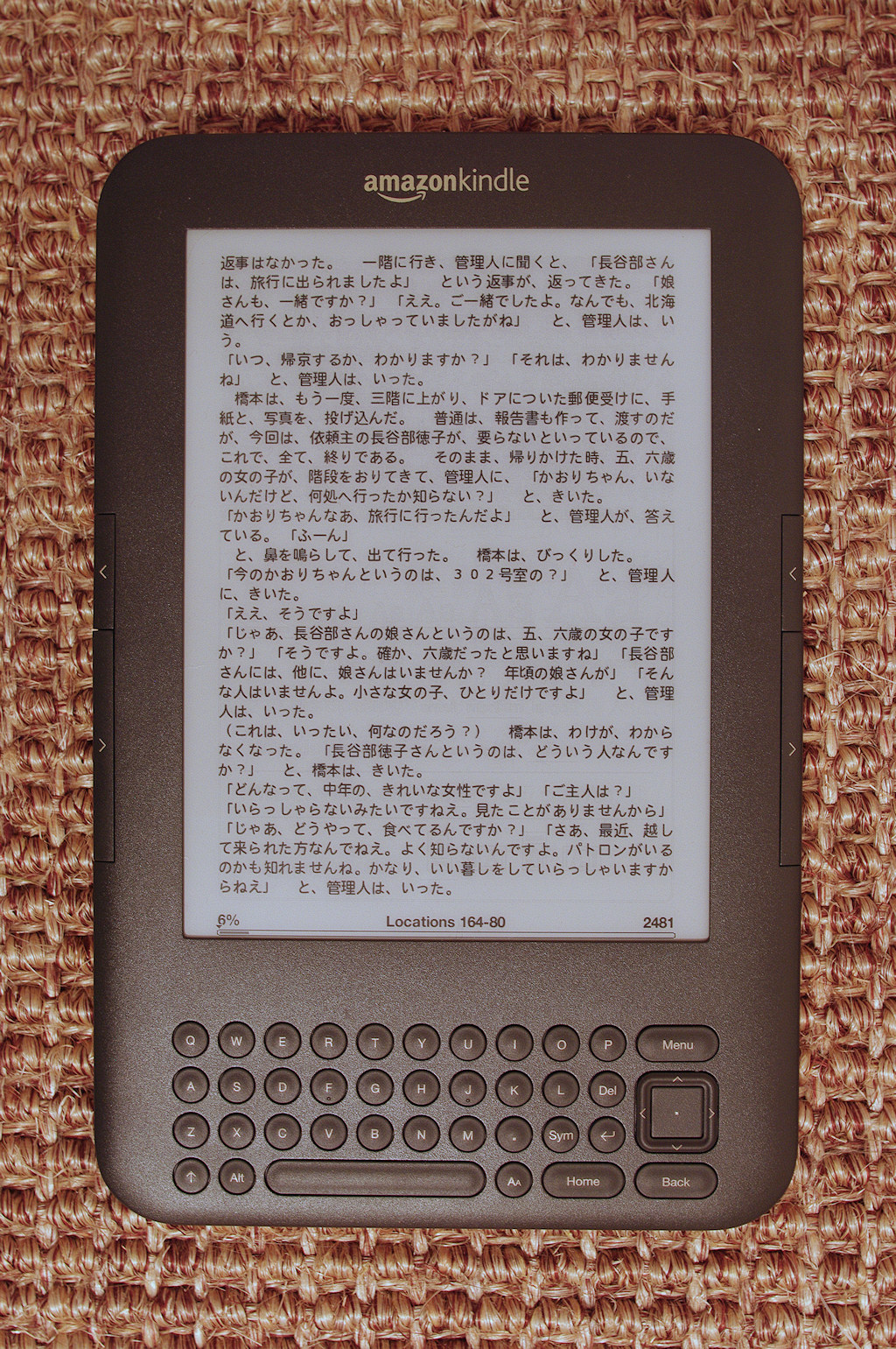
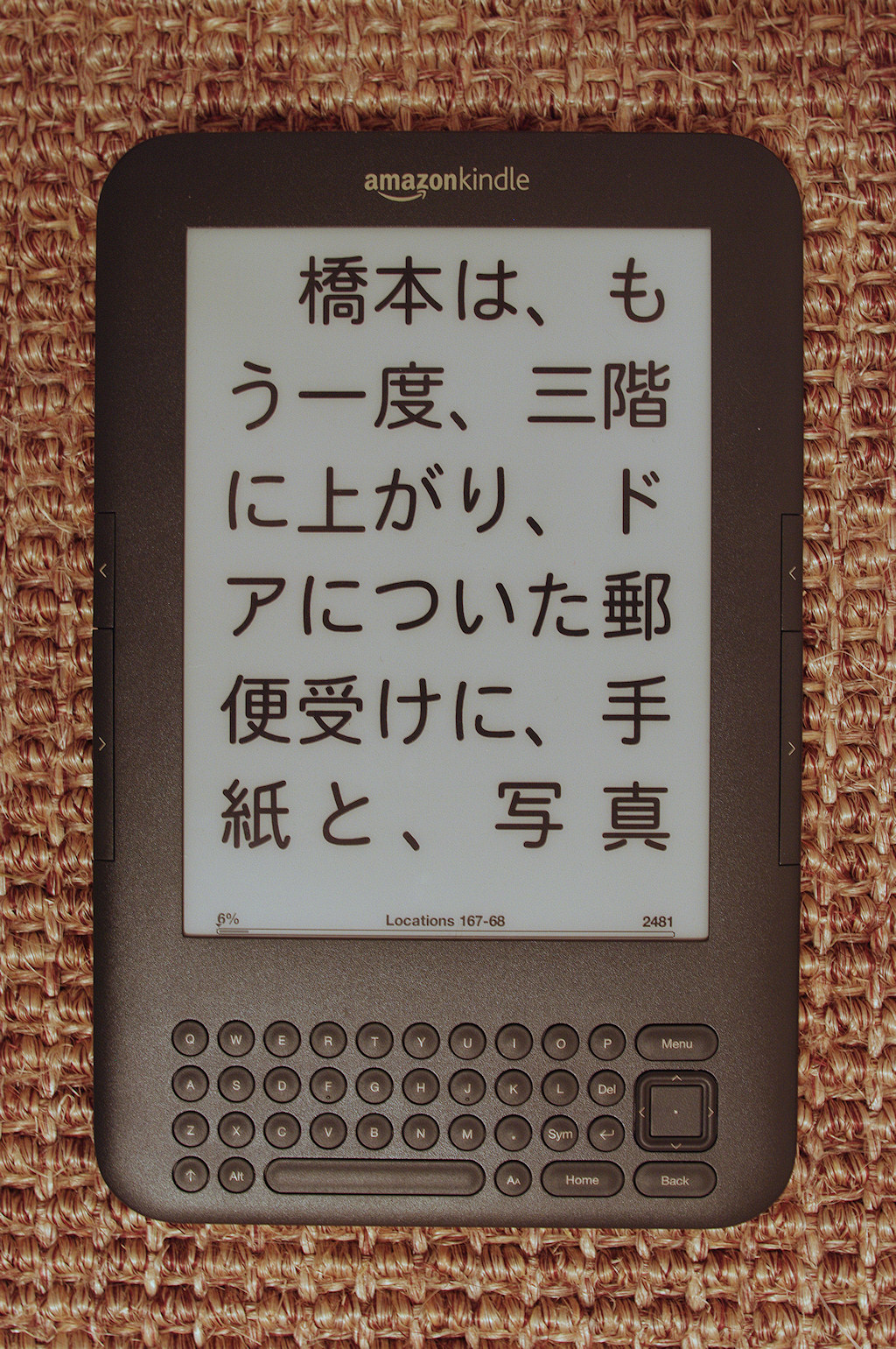
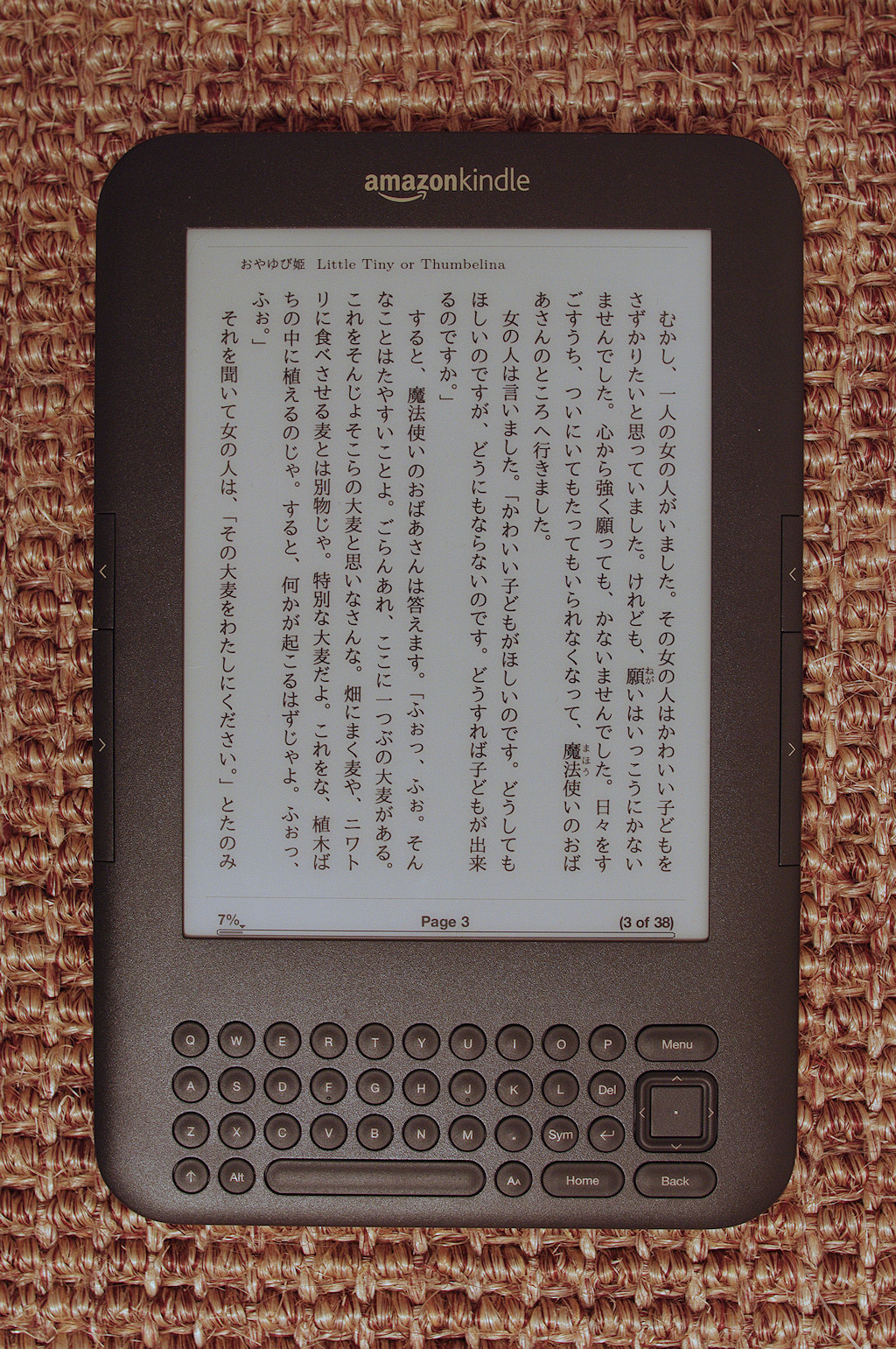
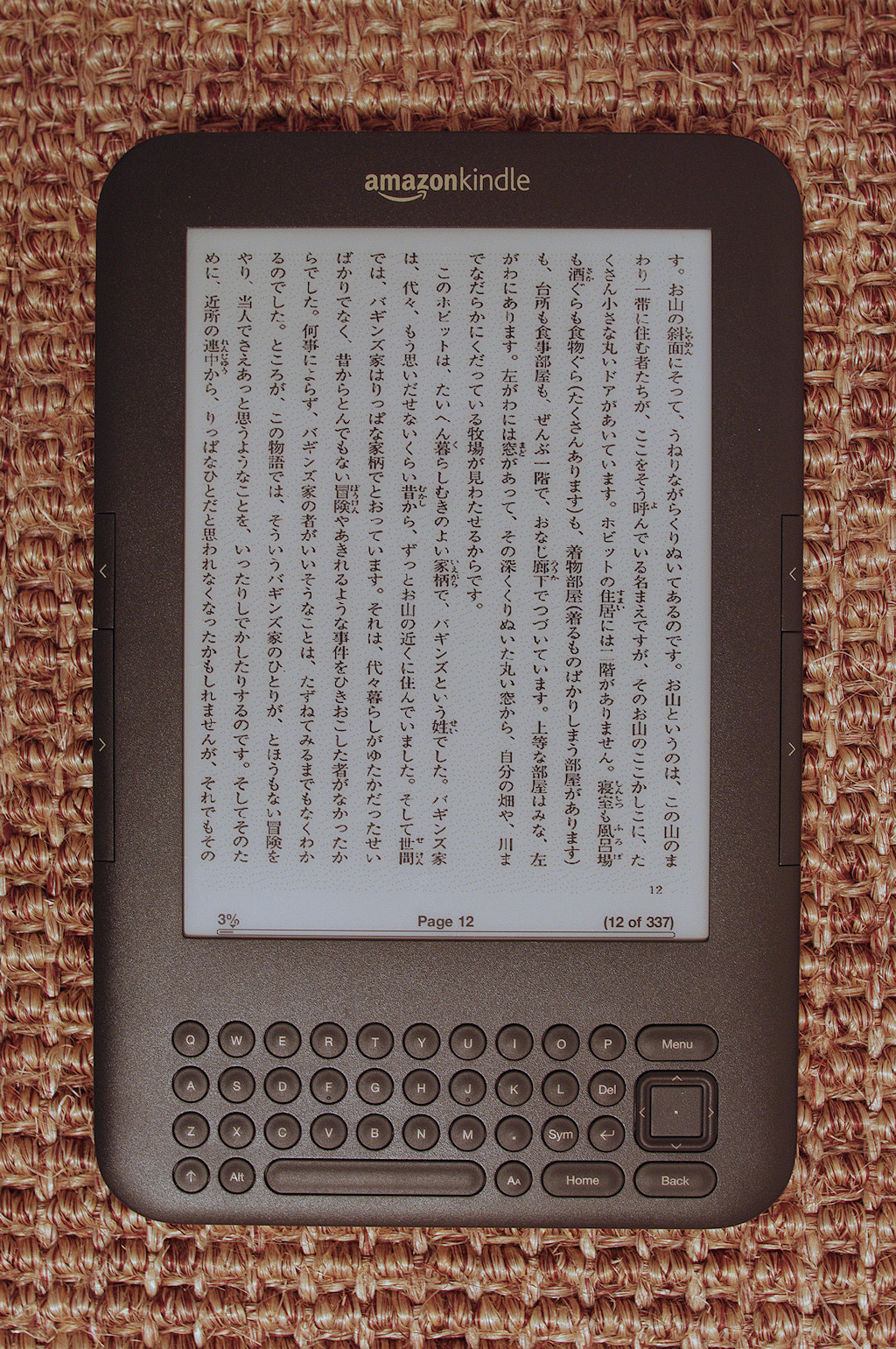
I took some photos of various text displays. I didn’t have a proper copy stand or light tent, so they’re not the best pictures ever, but you should be able to get some idea. Click for bigger versions.
Here is what a normal text file looks like on the Kindle, with the text size I’d usually use:
And with the smallest text:
And with absurdly large text:
You can put Aozora Bunko texts directly on the Kindle as well, but the best way is to use the online converter at A2K. This is extremely simple (instructions here) and results in a file that displays perfectly. Here’s a sample using the medium text size:
I haven’t tried using Mangle to put any manga on the Kindle yet, but I did try it with a book I happened across that was in a similar format, namely a collection of .png files. This didn’t really work very well at all. The text was very light and hard to read, and the pages were out of order – still don’t understand why, but the picture viewer on the Kindle is after all an undocumented experimental feature and one should perhaps not expect too much. What did work though (thanks again to BlackDragonHunt for the suggestion), is taking Mangle’s output, packaging it into a .zip file, changing the extension to .cbz, and opening it in Calibre. From there, you can output the resulting file into either a normal e-book format or a pdf, both of which work equally well. The display will depend heavily on the scan quality, but here’s what I ended up with for this book:
I bought the Kindle 3 mainly because of Aozora Bunko. There are a tremendous quantity of texts there of precisely the sort of thing I am working towards reading. Collecting hard copies of so many books would cost a fortune and take up a great deal of space; the Kindle cost less than $200, takes up no space at all to speak of, and (without any exaggeration at all) gives me access to years of reading. In short, I would wholeheartedly recommend it to any learner of Japanese.
Addendum:
BlackDragonHunt has put up a very good post here with more details on getting various filetypes onto your e-reader.
 Lan'dorien's Mysterious Journey